
Fayette Parole and Probation
Parole is supervised release from a TDCJ prison sentence before the sentence reaches its full end. Mandatory supervision is another form of supervised state release governed by eligibility rules. Both remain under the Texas Department of Criminal Justice Parole Division. Probation is different. A court places a person on community supervision instead of requiring all of the term to be served in custody, and the 155th District Community Supervision and Corrections Department manages adult probation in Fayette County.
The source of the order controls where to check. A TDCJ release certificate, parole status, or mandatory-supervision record points to the Parole Division. A Fayette court order placing a person on community supervision points to the local CSCD. Neither record alone establishes the exact hour someone walked out of Fayette County Jail.
| Issue | Parole or mandatory supervision | Probation |
|---|---|---|
| Source | TDCJ sentence and state release process | County or district court order |
| Office | TDCJ Parole Division, Austin I DPO | 155th District CSCD, La Grange |
| Best status proof | Public parole status and release certificate | Court order and CSCD confirmation |
| Actual exit proof | TDCJ certificate or sheriff release record | Sheriff release record when jail custody occurred |
- Parole
- Conditional community release before a prison sentence fully expires.
- Probation
- Court-ordered community supervision, often used instead of serving all of a custody term.
- Discharge
- The formal end of a sentence or supervision term.
- Absconder
- A supervised person alleged to have stopped reporting or left supervision without permission.
Verify Fayette Post-Release Supervision
Begin with the custody and sentence, not a guess based on the charge. The TDCJ Inmate Search can show current sentence details and Parole Review Information for a matching state prisoner. TDCJ also provides inmate information by email or telephone when the public locator no longer returns a fully discharged person. For local probation, the Fayette court file and the 155th District CSCD are the direct sources.
- Confirm whether the person left Fayette County Jail, a TDCJ unit, or another system.
- Read the court disposition or TDCJ sentence record to identify probation, parole, mandatory supervision, or direct discharge.
- For a state case, search by TDCJ or SID number when possible and open Parole Review Information.
- For probation, ask the clerk for the supervision order and contact the 155th District CSCD with the case details.
- Request the public release or discharge certificate when durable proof is needed.
A favorable parole vote is not the same as physical release. Texas release processing, any required program, release-plan approval, and a final records audit may still remain. For a completed county exit, the Fayette County released inmate search path leads back to the sheriff record and the correct court.
Fayette Supervision Offices Differ
Fayette County has a clear geographic split. The local probation office is in La Grange, but Fayette parole and mandatory-supervision cases are assigned to the Austin I District Parole Office. Calling the wrong office can produce an unhelpful no-record answer even when supervision exists.
155th District CSCD
227 North Washington Street
La Grange, TX 78945
Phone: 979-968-3814
TDCJ Austin I District Parole Office
3928 Promontory Point Drive
Austin, TX 78744
Phone: 512-926-4482
The TDCJ county assignment list links Fayette to Austin I, and the Region IV directory supplies the office details. Confirm current hours before visiting either office.
Fayette Parole Status Changes
Supervision conditions can include reporting, travel limits, treatment, monitoring, and special terms stated in the release certificate or court order. A claimed violation may lead to review, a warrant, added restrictions, or return to custody. It does not automatically prove a new crime or conviction. The current agency record should be read in context.
Texas provides a 24-hour absconder tip line, but it does not publish a general directory of all parole warrants. Its public specialized search is limited to absconding sex offenders. Therefore, a no-result cannot verify that an ordinary Fayette parolee has no warrant. Contact the supervising office for the lawful status channel.
Texas IVSS can send some later warrant or return-to-custody events for eligible TDCJ registrations. An alert is useful corroboration, not a complete supervision file.
Fayette Supervision Discharge Records
Supervision ends through a formal discharge, sentence expiration, court action, or another authorized disposition. Direct discharge means a state prisoner leaves incarceration without parole supervision because the sentence ends. A parolee or person on mandatory supervision remains under TDCJ authority until discharge unless another lawful change occurs.
TDCJ policy identifies release and discharge certificates plus certain public parole fields as releasable. Request a narrow certificate through the TDCJ Public Information Act route. Government Code section 508.313 protects much of the parole field file, so ask for the public status, release date, discharge date, and certificate instead of a broad confidential file. For probation, request the final court order or CSCD discharge record tied to the case.
Fayette Parole Review Results
Texas does not hold a formal public parole hearing with a daily calendar. A three-member panel reviews files and votes in sequence. Two matching votes decide the result. TDCJ generally identifies cases about six months before initial eligibility and about four months before a later review date, but eligibility is only the point when review may occur.
The Board's parole panel FAQ explains the no-hearing process. Use the person's TDCJ detail and Parole Review Information, or call the Board status line at 844-512-0461. After a favorable result, Review and Release Processing at 512-406-5202 addresses release processing. An FI code may require a program, while denial codes give reasons or a next review point.
The official explanation can be seen in the Texas Board source.
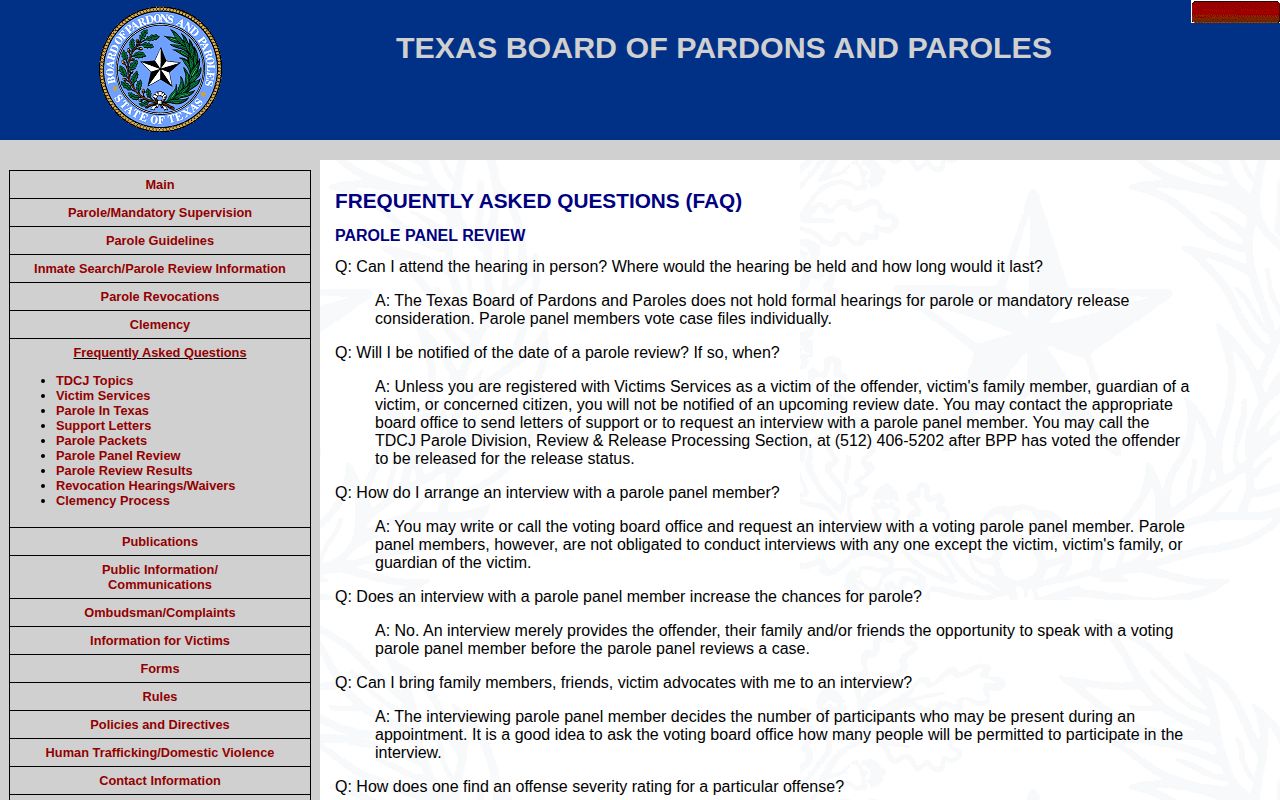
The captured panel guidance confirms that review and voting, not a public hearing calendar, control the process.
Fayette Release Basic-Needs Support
The TDCJ Reentry Resource Guide includes a Fayette County entry for A.M.E.N. at 805 Mode Lane in La Grange, with telephone 979-968-3943. It lists purpose-neutral food and basic-needs support during limited weekly hours. Call before traveling because schedules can change.
This local resource does not verify parole, probation, or release. The relevant government office still controls status and official records. Its role begins after release, when a person may need basic support while reconnecting with family or meeting supervision terms.
Fayette Supervision Record Channels
Public parole information can include the person's name, TDCJ number, status, assigned office, release type, and selected dates. Other parts of a parole field file remain confidential under Texas law. A narrow request for a release or discharge certificate is more useful than asking for the entire file. TDCJ accepts public-information requests by online form, email at PIA@tdcj.texas.gov, and mail to TDCJ Public Information Request, PO Box 4017, Huntsville, TX 77342.
Probation evidence starts with the court case. Fayette felony records are held by the District Clerk, while misdemeanor criminal records are held by the County Clerk. The District Clerk does not provide public online case files, though an in-office terminal covers open public cases. Ask for the community-supervision order, later modification, revocation or discharge order, and final disposition that apply to the named case.
A court order and a supervision record answer legal-status questions. They do not necessarily show the jail's booking release time. When the person was held at Fayette County Jail, request Booking Info from the sheriff and specify actual release date, time, disposition, and receiving agency. Matching those sources avoids calling a transfer a community release or mistaking probation for parole.
Note: Verify office assignment and public status again when a record is old, because supervision can end, move, or return to a court or custody process.