
No Fayette County 72-Hour Release Archive
The Fayette County Sheriff's official corrections page is a facility-information page, not a three-day release feed. It offers no named roster, release columns, window rule, update cadence, retention statement, or photo field. The research also found no separate 72-hour URL and no official county app that supplies such a view.
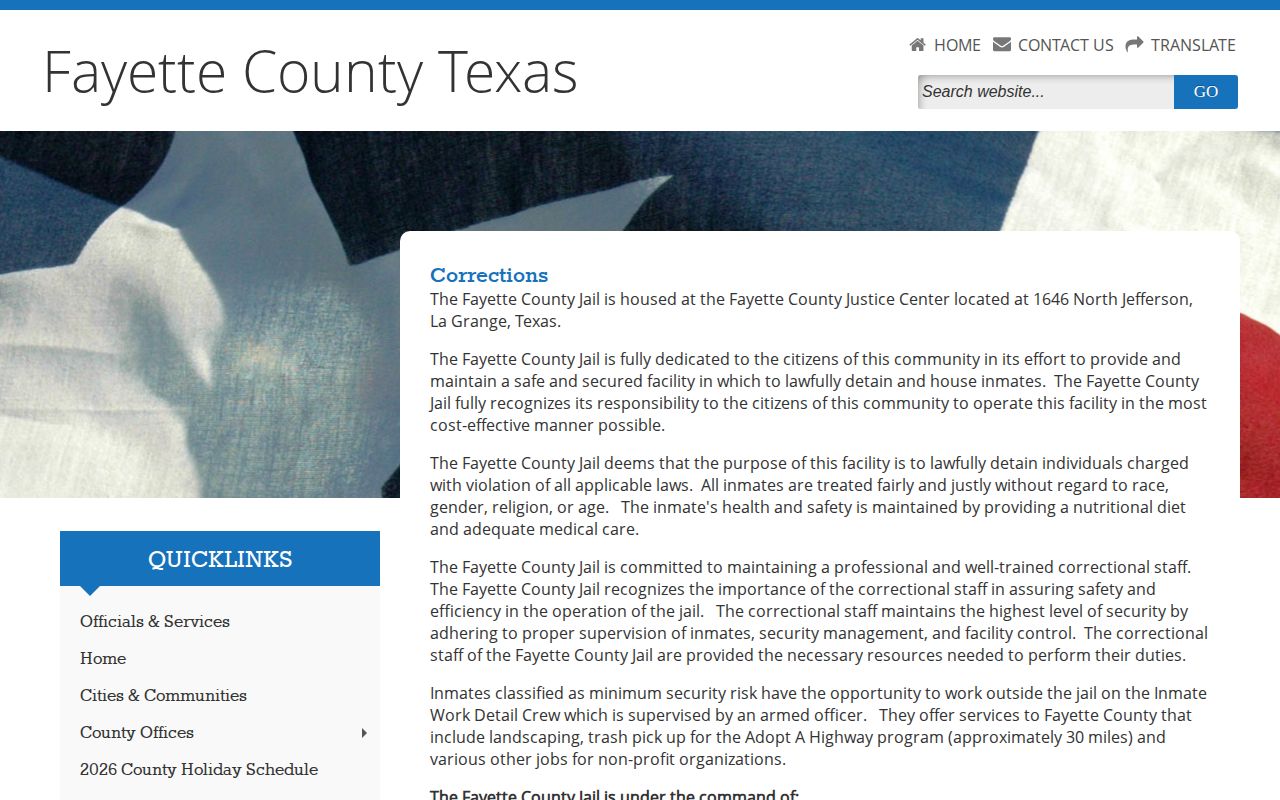
The Fayette County corrections page demonstrates the available interface. It describes the jail and services for people currently confined, while providing no release archive to browse.
A search result from a different state or a commercial roster cannot fill this gap. For Fayette County, Texas, a three-day review must be assembled through official requests and event-specific checks, not by copying names from an unrelated current-custody page.
Build a Fayette County Three-Day Check
Write down the three calendar dates and the local times that define the inquiry. That avoids ambiguity about whether “72 hours” means a rolling period or three named dates. Then use the county's available channels in sequence.
- Call the Sheriff's Office at 979-968-5856 and ask whether a named booking ended during the period and how the disposition was coded.
- Use the sheriff's open-records form, select Booking Info, and request actual release date and time, reason, booking number, and receiving agency or destination.
- Search IVSS-Counties for the specific person and confirm Fayette participation or data with the 24-hour operator at 866-268-8959.
- Match felony matters with the District Clerk and misdemeanor matters with the County Clerk to find the order or disposition behind the custody change.
- Follow a transfer into the receiving system, such as TDCJ, another county, BOP, or ICE.
For activity confined to today, the Fayette County 24-hour release check uses a tighter time frame and a same-day verification order.
Fields for Fayette County 72-Hour Records
Because there is no published field set, these are request targets rather than online columns. The sheriff's form accepts identifiers and event details and expressly includes Booking Info. Availability and disclosure still depend on the record held and Texas law.
| Field to request | Why it matters across three days |
|---|---|
| Name and booking number | Prevents two bookings or similar names from being combined. |
| Booking date and time | Identifies the custody episode that preceded the exit. |
| Actual release date and time | Places the completed event inside or outside the defined period. |
| Release disposition | Helps separate bond, time served, dismissal, and other court-authorized outcomes. |
| Destination or receiving agency | Distinguishes community release from continued custody elsewhere. |
| Case reference | Allows the matching clerk to locate the order that explains the change. |
A photo is not proof of release and does not show the disposition. If a booking image is needed for identity confirmation or a legal or personal record purpose, the same sheriff form includes a Photos category, but the agency decides whether the image may be disclosed.
Note: Request one named booking when possible, since a focused request is easier to match than a broad demand for an invented feed.
Fayette County Weekend Release Timing
A three-day frame is useful when the event may have occurred late Friday, over a weekend, or near a holiday. Fayette County has not published a weekend-release rule or a special release-processing schedule, so do not assume that a sentence endpoint moves to a business day or that office closure fixes the physical exit time.
Ask for the actual timestamp recorded after processing, not a projected date or the time of the court order. A bond, dismissal, or sentence completion may authorize release, yet identity checks, paperwork, another hold, or transfer arrangements can affect what happens next. The sheriff's completed entry answers when county custody ended.
Notification systems may update after the physical event. A court disposition may also be entered on a different date from the jail exit. That is why the wider period helps collect leads, while the record-level comparison supplies proof. For a named-person workflow that spans county, TDCJ, and federal sources, consult the Fayette County release search guide.
Request Fayette County Release History
Send the written request to the Fayette County Sheriff's Office at 1646 North Jefferson, La Grange, TX 78945. Renee Moreland is the published open-records custodian. The office lists 979-968-5856 for its main and records phone and 979-968-5080 for fax. State the exact three-day period, identify the person or booking if known, and ask whether each county exit was a release or transfer.
Texas Government Code Chapter 552 governs requests for existing public information. The agency may release responsive public material, redact protected details, rely on an exception, or seek an Attorney General ruling. Charges follow applicable cost rules unless another law controls. Fayette County does not publish a fixed release-record fee or retention period, so ask for an electronic cost estimate and confirm that the named booking remains available.
The ten-business-day response framework in state guidance is not a universal production deadline. It describes response options, which can include release, notice of availability, a ruling request, a statement that no responsive material exists, or reliance on a prior determination. The phone inquiry is useful for status, while the written request defines the historical record sought.
Why Fayette County Names Cannot Vanish Online
In counties with live rosters, readers may infer release when a name drops off. That inference is unavailable here because Fayette County publishes no live roster to establish when a name appeared, disappeared, or remained visible. There is also no stated retention window for a recent-release archive.
The absence of an online name proves nothing. It cannot distinguish release to the community, transfer to TDCJ, transfer to another county, or delivery to a federal or immigration agency. Use the release disposition and receiving-agency field, then check the destination system.
Texas IVSS-Counties can provide event notices for participating-county data, including release and transfer events, but Fayette coverage should be checked live or through the operator. A no-result remains inconclusive. The separate TDCJ IVSS service is for state-prison and supervision events, not the county booking record.
Note: County IVSS, TDCJ IVSS, court files, and sheriff records answer related but different parts of the same custody change.
Fayette County Court Confirmation
The court file often explains why a three-day custody review shows movement. Fayette County felony records are held by the District Clerk. That office expressly states that public records are not online and instead offers an in-office terminal for open public cases. Misdemeanor criminal files are with the County Clerk, whose advertised online deed and vital indexes do not serve as a criminal search.
Request the judgment, bond order, dismissal, sentence-credit document, or other disposition associated with the booking. The court record can explain authority for release, but it is not by itself the timestamp of the physical jail exit. Another hold may remain even after a favorable court action.
Fayette County Exit Destinations
Fayette County Jail is the only operational adult detention facility identified inside the county. A person can leave it for the community or move into another system. The correct next source depends on the destination shown in the county record.
| Exit | Verification path |
|---|---|
| Community release | Sheriff release entry and matching court disposition. |
| TDCJ transfer | TDCJ locator, information service, or state IVSS. |
| Other county transfer | Receiving county jail or records office. |
| Federal custody | BOP locator or named federal agency. |
| ICE custody | ICE Online Detainee Locator or its information line. |
A TDCJ projected date is a forecast, not proof of release. A BOP “not in custody” result only addresses federal custody. Each three-day finding must be read within its own system before drawing a conclusion.